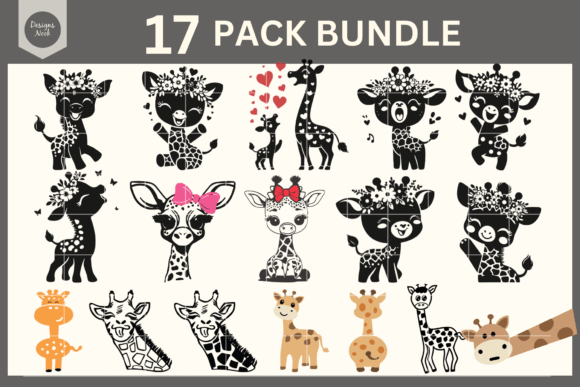
Giraffe SVG, Baby Giraffe SVG, Mom SVG
As a designer who’s stitched hundreds of custom pieces—from boutique baby onesies to Etsy-ready embroidered patches—I opened Giraffe SVG, Baby Giraffe Svg, Mom SVG expecting charm, but what stood out first was its quiet versatility. It doesn’t shout. It leans in—soft curves, gentle proportions, and a subtle interplay between adult and baby giraffe that feels warm without tipping into cutesy overload. That matters when you’re translating a vector into thread.
Last week, I used it for a client’s nursery-themed linen pillow cover: ivory cotton twill, 5” hoop, medium-weight cutaway stabilizer. The design scaled cleanly from 3.2” to 4.8” without distortion—no jagged edges, no collapsed limbs. That’s the SVG and EPS flexibility working as promised. But more importantly, the layout held up under stitch: the mom giraffe’s neck curved naturally over the baby’s back, leaving just enough negative space for fill stitches to breathe. No overcrowding. No dreaded “stitch pile-up” in the shared shoulder area—a common trap with poorly spaced dual-character designs.
This isn’t a design built for dense satin-stitched logos or sharp-edged monograms. It’s made for storytelling on fabric. Think: a lightweight cotton tote bag for a new mom’s baby shower, a relaxed-fit sweatshirt for a toddler’s first safari-themed birthday, or a tea towel hung in a sunlit kitchen. The silhouette reads clearly at 3–5”, holds warmth at 7”, and still feels intentional—not stretched thin—when enlarged for a blanket corner or nursery wall hanging.
Where it shines most is in handmade product context. As an Etsy seller myself, I know buyers scroll past cluttered, over-rendered graphics. Giraffe SVG, Baby Giraffe Svg, Mom SVG lands with sincerity. Its clean lines translate well into embroidery files—especially when converted thoughtfully (more on that below). Customers recognize authenticity: this isn’t stock clipart repackaged. It carries the weight of intention, which builds trust in your shop, your brand voice, and your finished product.
That said—don’t assume it’s plug-and-play for every surface. On stretchy jersey or thin rayon-blend tees, the open areas (like the gap between necks or the baby’s lifted hoof) need careful stabilizing. I tested it on a lightweight bamboo blend and added tear-away + light cutaway combo—otherwise, the fill stitches pulled slightly at the edges. On dark fabric? Use high-contrast thread (ecru on navy, charcoal on cream), and avoid ultra-fine details like eyelashes unless your machine handles 60-weight thread consistently. Tiny features vanish fast in dense fill or low-res stitching.
Curved surfaces demand extra attention. I tried it on a structured cap front—hoop size limited to 4” width—and found the baby giraffe’s head sat beautifully, but the mom’s neck bent awkwardly near the crown seam. For caps or aprons with deep darts, consider simplifying the neck curve manually before digitizing, or use it only in flatter zones like pocket corners or bib fronts.
It’s also not ideal for tiny hoops under 3”. The connection point between the two giraffes—the gentle overlap where their heads meet—is delicate. At sub-3” scale, that detail blurs, turning into a muddy stitch blob rather than a tender gesture. Save it for 3.5”+ projects unless you’re willing to simplify the vector yourself in Illustrator or Inkscape.
For commercial embroidery work—say, stitching 50 matching sweatshirts for a daycare staff gift—the design’s balanced density helps. It avoids heavy satin borders or micro-details that slow down machines or increase thread breaks. You’ll get clean runs across multiple garments, especially if you adjust underlay and pull compensation for your specific fabric stack. Just remember: test on scrap first. Always.
Here’s what I do before committing to any embroidery file derived from Giraffe SVG, Baby Giraffe Svg, Mom SVG:
- Run a black-and-white mockup—not just color—to check contrast and legibility on both light and dark backgrounds;
- Inspect small junctions (hoof-to-ground, ear tips, eye dots) for stitch feasibility—not all vectors digitize cleanly;
- Confirm stabilizer match: lightweight for tea towels, firm cutaway for knits, mesh for patches;
- Compare thread colors live, not just on screen—lighting changes everything;
- Check licensing terms before selling finished items or bundling the SVG as part of a digital product kit;
- Use it in context: lay it over a real tote bag mockup or onesie template—not just a blank canvas.
One unexpected win? This design works beautifully as a foundation for appliqué. The clear outer contour and minimal internal breaks make it easy to trace for fabric placement, then outline with satin stitch. I added raw-edge cotton flannel for the baby giraffe and smooth twill for the mom—gave it instant texture and depth without complicating the stitch file.
If you’re building a craft business around personalized gifts, Giraffe SVG, Baby Giraffe Svg, Mom SVG fits right in—not as a standalone hero, but as a reliable, emotionally resonant element. It supports your brand instead of competing with it. Pair it with simple typography (“Little One, Big Love”) or let it stand alone on a folded kitchen towel—it carries quiet confidence.
It won’t replace technical precision files for corporate branding or intricate heirloom embroidery. But for heartfelt, human-scaled projects—baby embroidery, holiday embroidery, custom apparel with soul—it earns its place in your design assets. Not because it’s flashy, but because it’s thoughtful, adaptable, and quietly professional.
Before you drop it into your next embroidery project: open that ZIP, preview both SVG and EPS versions, and ask yourself—does this feel like something your customer would hold, smile at, and keep? With Giraffe SVG, Baby Giraffe Svg, Mom SVG, the answer—most days—is yes.